

Arizona Skateboarding: How a Generation, a Shop, and a Crew Built a Culture – It’s History!
By Aaron G. Beebe | Owner & Founder, GonnaHappen

Arizona Skateboarding: How a Generation, a Shop, and a Crew Built a Culture – It’s History!
Skateboarding didn’t always belong in Arizona.
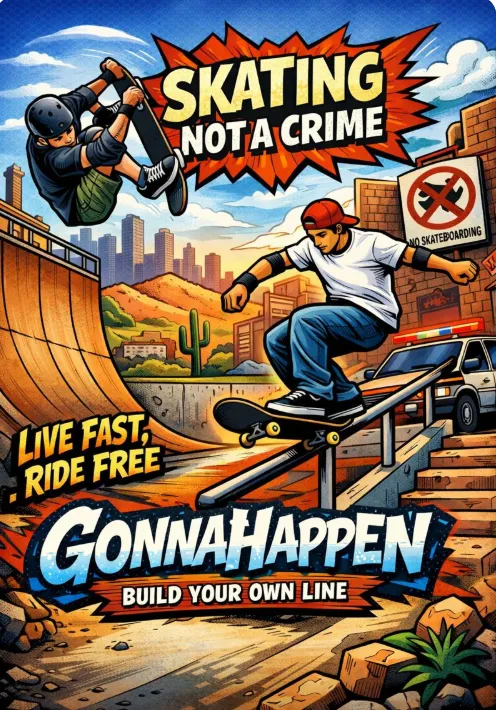
In the late 1990s and early 2000s, skating in Phoenix and Tempe was treated less like a culture and more like a crime. Security chased kids out of plazas. Cops wrote tickets for rolling through empty lots. There were very few legitimate skateparks, and almost no understanding from city leadership.
What changed Arizona forever wasn’t a single contest, video, or park.
It was people.
This story is drawn from lived experience, long friendships, and the deep community record preserved inside the AZ Skateboarding History group—an ongoing archive of the people who actually built the scene. And for me personally, this is the era that raised me, my friends, and an entire generation.
Cowtown Skateboards — The Anchor
Cowtown Skateboards opened its doors in 1997 in Phoenix, founded by Trent Martin and Ed Cox Jr. (widely known in the scene as Ed “Phoebe” Shouse). From the beginning, Laura Martin was not “in the background”—she became central to the shop’s operations and the wider skateboarding community that formed around it. (Cowtown Skateboards)
From day one, Cowtown was skater-owned, skater-run, and community-first.
It wasn’t a mall shop.
It wasn’t chasing trends.
It was a home base.
And that detail matters, because Arizona in that era wasn’t a place handing out easy wins to skateboarders. If you were a skater, you needed somewhere that felt like yours—a place where the culture wasn’t being explained or defended every five minutes. Cowtown became that place.
As Cowtown grew, its presence became bigger than Phoenix. The expansion into Tempe and Flagstaff helped pull the state’s scenes closer together and turned Cowtown into a hub that skaters could rely on—desert heat or mountain snow, college streets or suburban lots, it didn’t matter. The brand and the community moved with it.
The Jersey Pipeline — East Coast Grit Meets Desert Concrete
By the late ’90s and early 2000s, Arizona started pulling skaters from across the country—especially the East Coast. In the community memory, it’s often talked about like a current you could feel: a steady flow of “New Boys from Jersey” trading winter for sunshine, and bringing a harder edge to street skating in the Valley.
That informal migration became known as the “Jersey pipeline.”
Among the most influential names connected to that energy:
Jason “Jay” Miller
Jay brought a raw, fearless, no-frills street presence to Tempe and Phoenix. He wasn’t skating for attention—he was skating for the session, for the crew, and for progression. The kind of skater who shows up, holds it down, and quietly raises the level for everyone around him.
The Miller Brothers (the “Jersey twins”)
Often remembered in that shorthand—“the Jersey twins”—they represented a shift toward aggressive, spot-driven street skating. Fast, powerful, and relentless, they embodied an East Coast mentality that blended perfectly with Arizona’s endless concrete and wide-open terrain.
This wasn’t about labels or contracts. It was about showing up every day, stacking sessions, and turning the desert into a proving ground.
Scott Wilson & Will McCaffrey — Building the Bridge
While many skaters were pushing progression in the streets, Scott Wilson and Will McCaffrey were doing something equally important: translating skateboarding to the people in charge.
That’s a big part of why the Arizona story is different. Plenty of scenes have talented skaters. Not every scene has people willing to sit through meetings, push for infrastructure, and fight to make skateboarding legible to city planners who didn’t understand it.
Scott Wilson became one of the most important connectors in Arizona skate history—someone who could speak skate culture and “city language.” Cowtown’s growth and influence weren’t accidental; it came from a mix of authentic shop culture and real community organizing. (Thrasher Magazine)
Will McCaffrey helped operationalize that growth—expanding reach and helping solidify regional connections, including bridging the Phoenix metro energy with Northern Arizona’s scene as Cowtown’s footprint grew.
Together, they helped build key pieces of what people recognize today as the Cowtown foundation: not only a shop presence, but a statewide network of community events, premieres, demos, and the early momentum that eventually supported a larger nonprofit pipeline through Cowtown S.K.A.T.E. (The Platfrm)
Advocacy Before Aesthetic — The Parks Were Fought For
The skateparks people enjoy today were not gifts.
They were earned.
Before Arizona became known for world-class concrete, the community had to prove—over and over—that skateboarding wasn’t vandalism and skaters weren’t the enemy. The turning point wasn’t some marketing campaign. It was building real spaces and showing what happens when skaters are given legitimate ground.
Desert West Skatepark (1997) — The First Domino
In 1997, two things happened that permanently changed Phoenix skateboarding: Cowtown opened and Desert West Skatepark opened. Community accounts consistently tie both to the same core coalition of people who refused to let skateboarding be erased. (The Platfrm)
Desert West is widely recognized in the community as a foundational concrete park for the Valley—proof that skaters would respect a real park, and proof to the city that skateparks are community assets, not liabilities. Reporting and community features also note Laura Martin’s long-running role working with the city on skatepark efforts dating back to the ’90s. (North Central News)
Desert West proved three things to Arizona leadership:
- Skaters would respect a real park
- Conflict decreases when you give skateboarding a place to exist
- Skateparks are community infrastructure—just like courts, fields, and rec centers
Once Desert West succeeded, the argument against skateparks started collapsing.
Tempe Beach Park & the Transition Era
Tempe’s rise is inseparable from the broader push to make skateparks functional instead of symbolic. The goal wasn’t “a park that looks good in renderings.” The goal was a park that actually skates—built with the reality of boards, speed, transitions, and flow.
That’s why early spots and parks get talked about like landmarks: Tempe Beach Park, The Wedge, Pecos—not just because they existed, but because they showed what happened when skating was taken seriously.
Fine and Dandy (2003) — Capturing an Era
If you want to understand a scene, you don’t just look at the parks—you look at what the cameras were chasing.
The release of Fine and Dandy (2003) is remembered as a high-water mark because it captured the transition: Arizona going from “underground and chased” to “organized and undeniable.” It documented a specific energy—Jersey grit blended with Arizona flow—and the type of skating that could only come from daily sessions and constant spot hunting.
Much of this era’s visual truth is closely tied to “Rookie”, whose VX lens preserved what the scene actually looked like before everything became polished, optimized, and branded.
Premieres weren’t just screenings. Places like Madcap Theater were where the scene gathered, celebrated, and took inventory of what it was becoming—together.
My Life Inside This Era — Friends, Sessions, and Identity
This wasn’t something I watched from the outside.
These were my years, my friends, my community.
I grew up around this energy—skating, filming, hanging around shops, parks, and sessions that shaped how I see culture, loyalty, and creativity today. Skateboarding in that era wasn’t just a hobby; it was identity. It was your network. It was how you learned who you could trust. It was how you found your people.
Friends like Colby Carter were part of that broader circle—people connected through skating, music, art, and shared time. Even if everyone didn’t skate the same obstacles or appear in the same edits, the culture tied us together.
Skateboarding taught us:
- How to show up
- How to support each other
- How to build something real without permission
Those lessons still drive GonnaHappen today—the same “community-first” DNA, just expressed through a different platform and a different era.
Remembering Jason “Jay” Miller
After Arizona, Jay eventually moved to Portland, Oregon, where he remained part of the skate community.
On July 23, 2017, Jason Miller and another victim, Taher Ali Alhaji, were killed in a deliberately set apartment fire in Northeast Portland. (KATU)
In September 2021, Ryan Thomas Monaco was sentenced to life in prison with a minimum of 38 years for the 2017 murders, according to the Multnomah County District Attorney’s Office and coverage of the sentencing. (MCDA)
To outsiders, it was a news story.
To us, it was devastating.
Jay is remembered not for how he died—but for how he lived:
- Loyal
- Present
- Fearless on a board
- Always down for the session
His name still carries respect from New Jersey to Arizona to Portland.
The Legacy — Concrete That Tells the Truth
Arizona didn’t become a skateboarding destination by accident.
It was built—meeting by meeting, session by session, park by park.
Because of this generation and this culture:
- Cowtown is still skater-owned and community-driven, with roots going back to 1997 (Thrasher Magazine)
- Desert West and Cowtown’s opening year became a defining “before/after” moment in Phoenix skateboarding (The Platfrm)
- PHX AM grew into a major desert proving ground—documented as an annual, large-scale event pulling serious talent and media attention (Phoenix New Times)
The concrete remembers.
And so do we.
—
Aaron G. Beebe
Founder, GonnaHappen
📞 530-457-5988
✉️ aaron@gonnahappen.com
🌐 Websites:
🔗 Socials:
- 📸 Instagram – @gonnahappendotcom
- 📘 Facebook Page
- 🐦 Twitter / X – @gonnahappencom
- ▶️ YouTube – GonnaHappen Channel
- 📸 Instagram – @aarongbeebe
- 📘 Facebook Share Page
🎉 Tagline:
GonnaHappen – VIP Experiences & Clothing
🌍 Bringing the World of Entertainment to You


Comments
рулонные шторы с электроприводом
- Log in or register to post comments
PermalinkОгородный фитнес: пашем и худеем
- Log in or register to post comments
Permalinkсео блог
- Log in or register to post comments
Permalinkсео блог
- Log in or register to post comments
Permalinkумные шторы
- Log in or register to post comments
Permalinkэлектрические жалюзи
- Log in or register to post comments
Permalinkрулонные шторы на пластиковые окна с электроприводом
- Log in or register to post comments
Permalinkэлектрокарниз купить
- Log in or register to post comments
Permalinkавтоматический карниз
- Log in or register to post comments
PermalinkКухни на заказ
- Log in or register to post comments
PermalinkКухни на заказ
- Log in or register to post comments
PermalinkКухни СПБ
- Log in or register to post comments
PermalinkКухни на заказ
- Log in or register to post comments
PermalinkКухни СПБ
- Log in or register to post comments
PermalinkКухни на заказ
- Log in or register to post comments
PermalinkКухни СПБ
- Log in or register to post comments
Permalinkгидроизоляция подвала изнутри цена
- Log in or register to post comments
Permalinkусиление проемов
- Log in or register to post comments
Permalinkгидроизоляция подвала изнутри цена
- Log in or register to post comments
Permalinkгидроизоляция цена
- Log in or register to post comments
Permalinkгидроизоляция цена
- Log in or register to post comments
Permalinkгидроизоляция цена
- Log in or register to post comments
Permalinkусиление проемов
- Log in or register to post comments
Permalinkремонт бетонных конструкций усиление
- Log in or register to post comments
PermalinkНарколог на дом
- Log in or register to post comments
Permalinkгидроизоляция подвала самара
- Log in or register to post comments
PermalinkНаркологическая клиника
- Log in or register to post comments
PermalinkНарколог на дом
- Log in or register to post comments
Permalinkинъекционная гидроизоляция
- Log in or register to post comments
PermalinkВывод из запоя
- Log in or register to post comments
PermalinkВывод из запоя
- Log in or register to post comments
Permalinkпродвижение сайтов по трафику
- Log in or register to post comments
Permalinkпродвижение сайтов в москве
- Log in or register to post comments
Permalinkseo кейсы
- Log in or register to post comments
Permalinkпродвижение сайтов по трафику
- Log in or register to post comments
Permalinkпродвижение сайтов по трафику
- Log in or register to post comments
Permalinkseo кейсы
- Log in or register to post comments
Permalinkпродвижение сайтов в москве
- Log in or register to post comments
Permalinkseo кейсы
- Log in or register to post comments
Permalinkпродвижение сайтов в москве
- Log in or register to post comments
Permalinkсолнечная энергия
- Log in or register to post comments
Permalinkпродвижение сайтов в москве
- Log in or register to post comments
Permalinkseo блог
- Log in or register to post comments
Permalinkseo блог
- Log in or register to post comments
Permalinkпродвижение сайта по трафику
- Log in or register to post comments
Permalinkпродвижение сайта по трафику
- Log in or register to post comments
PermalinkКухни на заказ
- Log in or register to post comments
Permalinkseo кейсы
- Log in or register to post comments
Permalinkseo блог
- Log in or register to post comments
Permalinkпродвижение сайта по трафику
- Log in or register to post comments
Permalink