

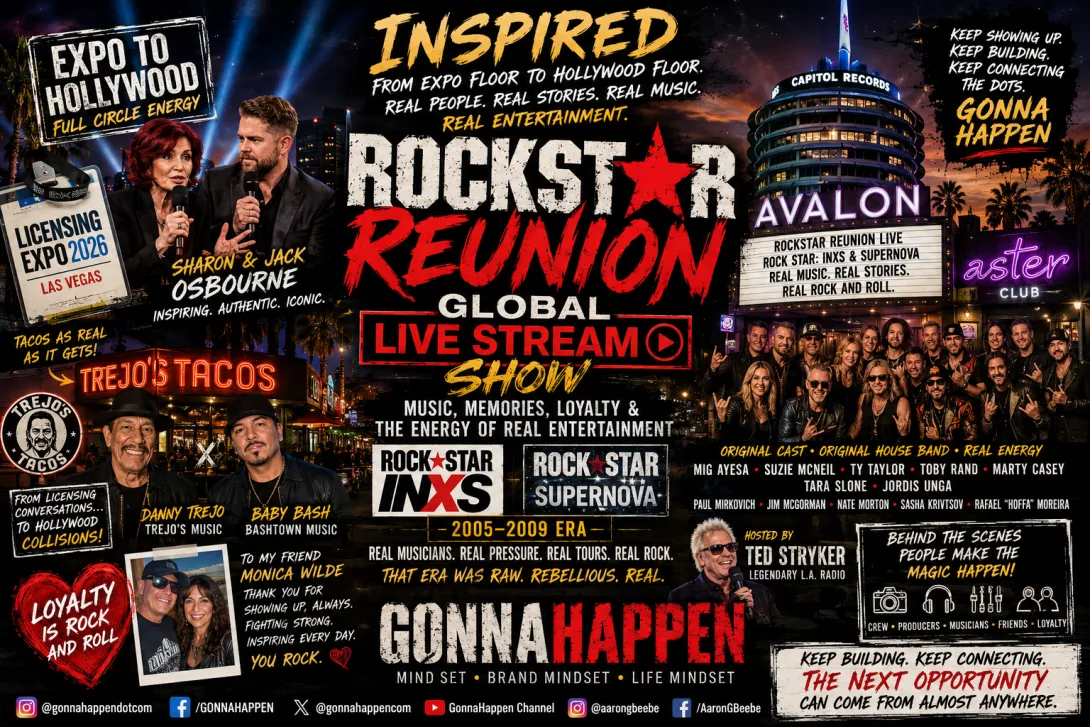
Rockstar Reunion Global Live Stream Show: Music, Memories, Loyalty & The Energy of Real Entertainment
By Aaron G. Beebe | GONNA HAPPEN
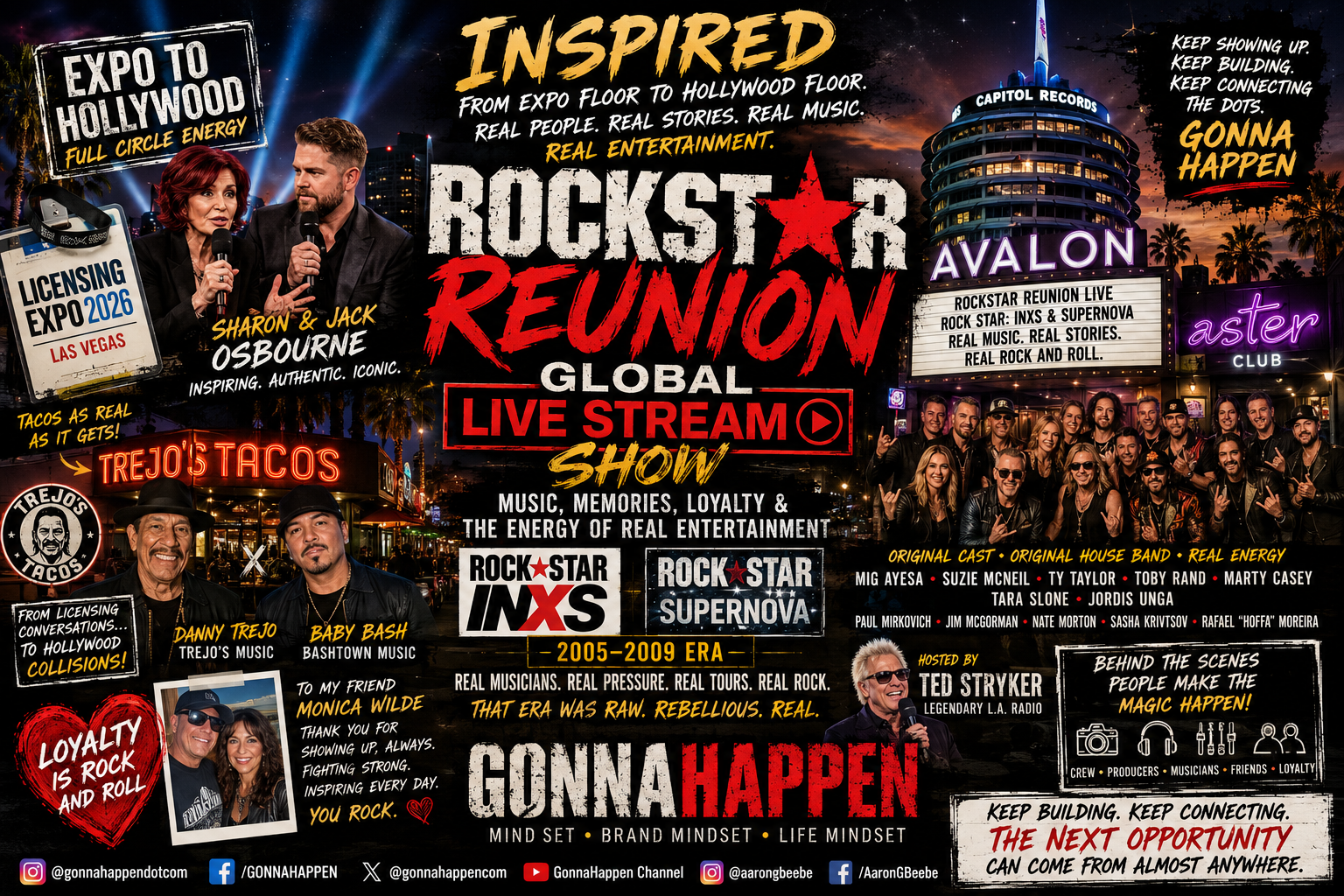
From Licensing Expo to Rockstar Reunion - Hollywood
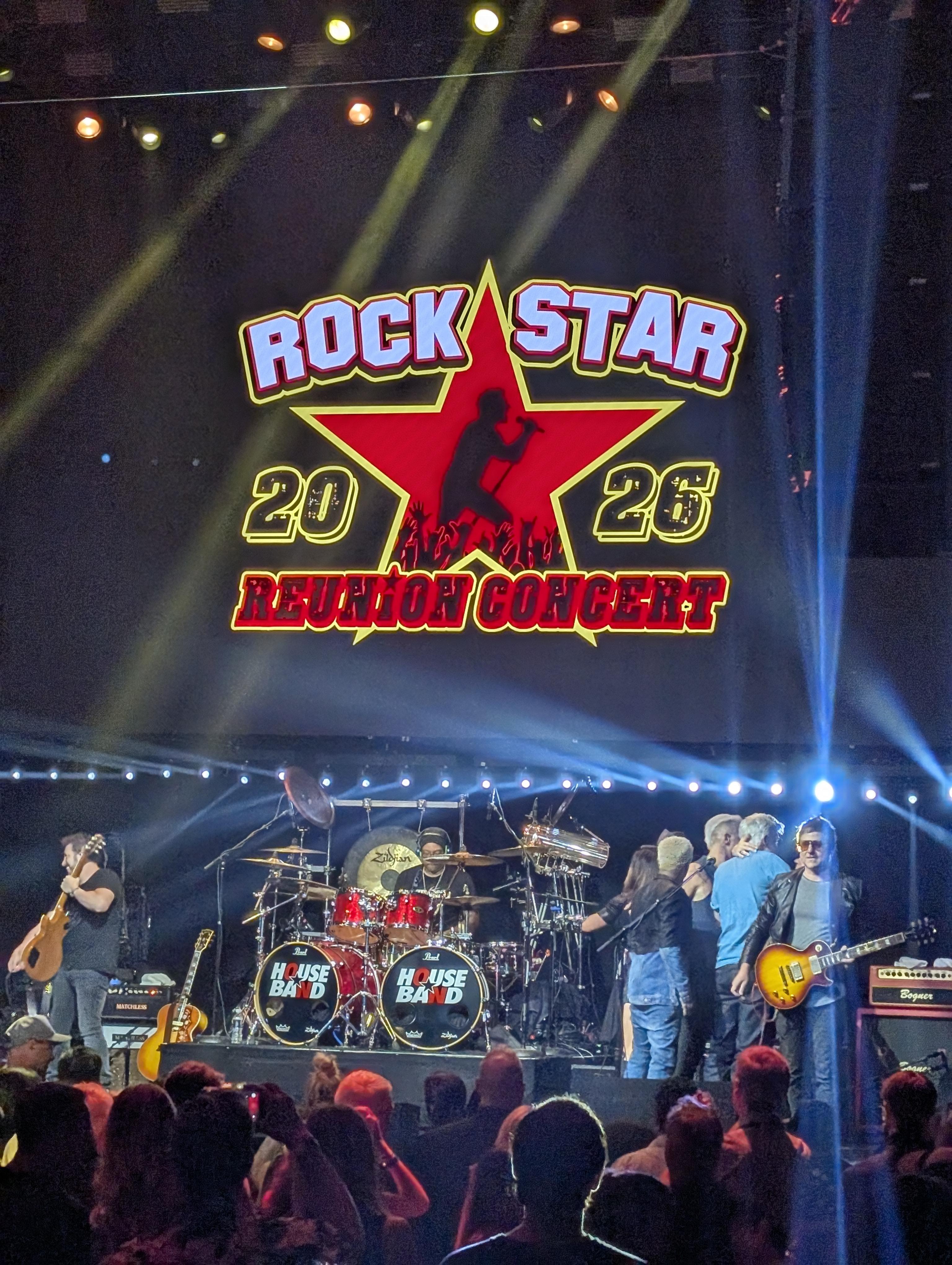
Sometimes the best entertainment experiences happen completely unexpectedly.
After spending three days at the 2026 Licensing Expo in Las Vegas learning more about licensing, branding, media, and the future of intellectual property for my word marks GONNA HAPPEN and Gonna Happen, I was already running on pure adrenaline.
Watching Sharon Osbourne and Jack Osbourne speak about the legacy of Ozzy Osbourne, Osbourne Media House, entertainment, branding, authenticity, and protecting an iconic family name honestly left me inspired and motivated.
Then life randomly shifted gears again.
My longtime friend Monica Wilde — someone who has supported me and GONNA HAPPEN since the very beginning — reminded me that the Rockstar Reunion Global Live Stream Show was happening Thursday night.
Monica has been going through chemotherapy and radiation treatments recently, so despite being exhausted from walking the Licensing Expo floor all week, I wrapped up early Thursday at the expo, rushed out toward Simi Valley to pick her up, and we headed straight into Los Angeles and Avalon Hollywood.
And honestly… that drive itself felt like part of the story.
Entertainment has always been weirdly interconnected like that.
One moment you’re walking a major licensing convention talking about trademarks, media expansion, branding strategy, celebrity IP, and the future of entertainment business…
The next moment you’re flying down the freeway — or jumping on a plane toward Hollywood or somewhere else across the country — chasing entertainment culture, music nostalgia, live conversations, creative energy, networking opportunities, concerts, events, and the people who have supported your journey since day one.
Hollywood Collisions, Trejo’s Tacos & Entertainment Culture
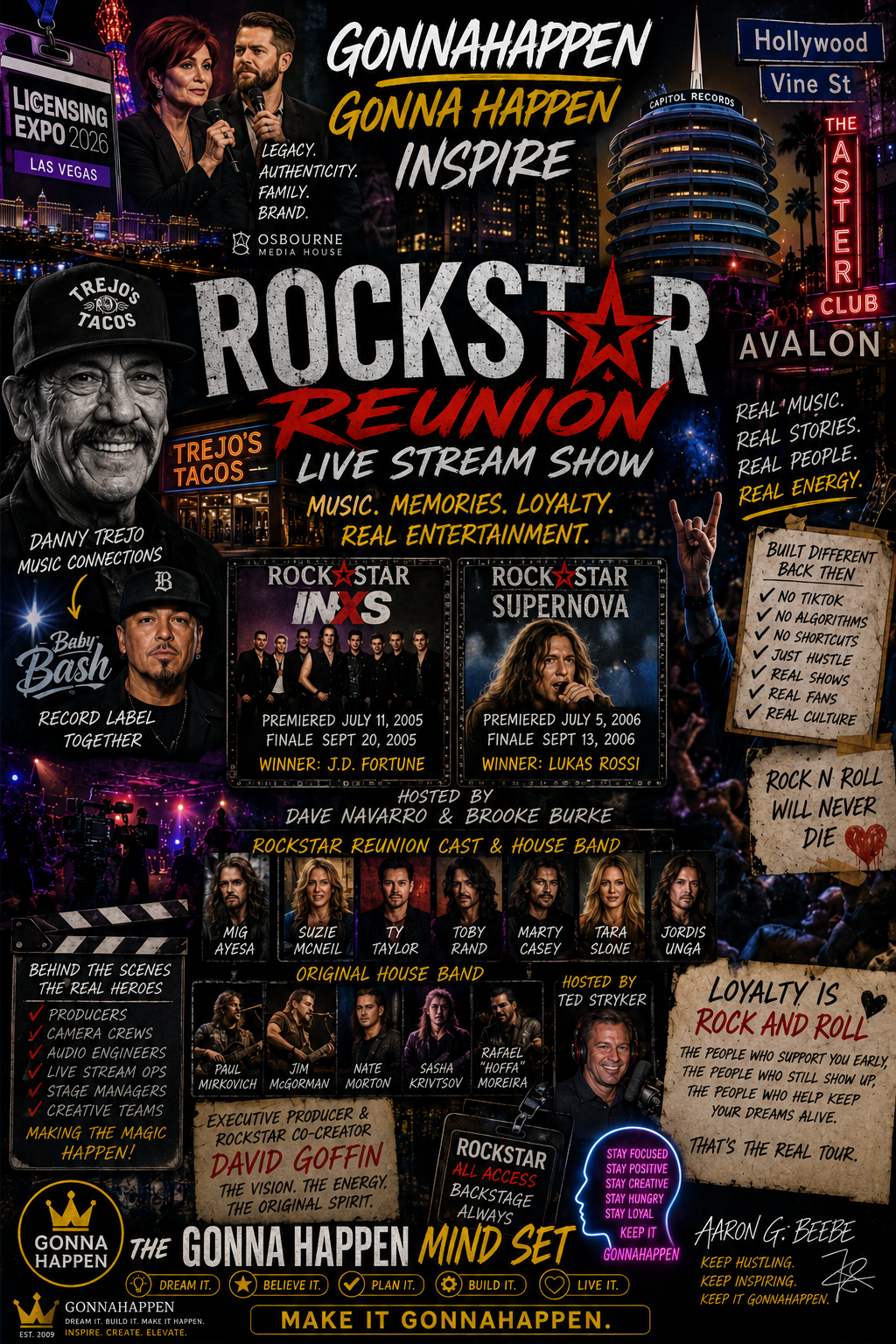
We ended up parking right next to Trejo’s Tacos, which instantly made the entire night feel even more surreal.
Just hours earlier, I had been walking the floor at the 2026 Licensing Expo in Las Vegas learning more about branding, media, licensing, and the future of intellectual property connected to my word marks Gonna Happen.
While at the expo, I had conversations with licensing representatives connected to Danny Trejo, hearing advice about branding, licensing growth, entertainment expansion, and long-term vision.
Then suddenly, only hours later, I’m standing in Hollywood parked next to Trejo’s Tacos heading into the Rockstar Reunion event.
That’s the kind of strange full-circle energy that constantly happens in entertainment.
And honestly, it got even crazier for me personally because Danny Trejo’s music connections instantly reminded me of Baby Bash — one of my favorite artists from back in the day who also happens to be connected to some people I know personally.
Danny Trejo’s Trejo’s Music and Baby Bash’s Bashtown Music connection made the entire moment feel like another one of those unexpected Hollywood entertainment collisions that somehow keep happening throughout music and media culture.
You can also follow Danny Trejo on Instagram and Baby Bash on Instagram.
That older era of music, nightlife, entertainment, radio culture, custom car scenes, MySpace music promotion, club flyers, reality television, and early social media marketing felt completely different because it still felt raw, local, emotional, unpredictable, and real.
Artists like Baby Bash and Danny Trejo were building fanbases through street promotion, live shows, radio stations, message boards, flyers on car windshields, nightclub appearances, pager messages, phone calls, and real personal relationships long before algorithms and short-form content controlled entertainment visibility.
People had to hustle differently.
Network differently.
Promote differently.
Entertainment still had grit to it.
And honestly, that authenticity is part of why so many people still feel nostalgic about that entire generation of entertainment culture today.
One of the things I keep realizing more and more is how interconnected so many of these entertainment stories really are.
From reality television, music culture, nightlife, Vegas, Hollywood, licensing, radio, fashion, celebrity branding, and now livestream media — so many people, shows, events, and experiences somehow continue crossing paths in unexpected ways.
That has honestly been part of my own journey too.
Back during that 2005 through 2009 era, I was personally diving head-first into the entertainment industry myself — meeting people, learning the business, chasing opportunities, building relationships, and trying to understand how music, nightlife, celebrity culture, branding, and media all connected together.
Some of those stories go back even before that era, and some of those same relationships and connections still exist today.
That’s why this Rockstar Reunion experience felt bigger than just one livestream event.
It felt like another reminder that entertainment is ultimately built through people, timing, loyalty, memories, relationships, and those strange full-circle moments that only make sense years later.
In many ways, that has always been part of the GONNA HAPPEN mindset too:
Keep showing up.
Keep building.
Keep networking.
Keep connecting the dots.
And keep believing the next opportunity can come from almost anywhere.
The Reality TV & Music Culture Era That Felt Real
One of the biggest things that made the Rockstar Reunion atmosphere hit differently for me was remembering how important and unique that original 2005–2009 entertainment era really was.
Back then, reality television competition shows were still evolving and entertainment culture itself felt completely different.
America’s Got Talent was only beginning in 2006, So You Think You Can Dance was still new, The X Factor had not yet exploded in the United States, and even Star Search still carried cultural relevance from an earlier television era.
At the same time, shows like The Girls Next Door, The Olly Girls, Sunset Tan, Rock of Love with Bret Michaels, Flavor of Love, I Love New York, Keeping Up with the Kardashians, The Simple Life, and eventually For the Love of Ray J were helping shape celebrity, nightlife, and pop culture from roughly 2005 through 2009.
It was a wild entertainment period where MTV, VH1, paparazzi culture, Vegas nightlife, Hollywood clubs, celebrity blogs, MySpace music promotion, and early social media were all colliding together at once.
People weren’t just watching celebrities anymore — they felt emotionally connected to entire lifestyles, music scenes, fashion trends, relationships, tours, clubs, and entertainment personalities in real time.
And honestly, during that exact era, I was personally diving head-first into the entertainment industry myself.
That period crossed paths with so many different parts of music, nightlife, Vegas culture, Hollywood, celebrity branding, radio promotion, and reality television all at once.
I’ll probably go deeper into some of my own personal experiences and connections surrounding certain shows, personalities, nightlife scenes, and entertainment circles later from a much more personal perspective because that entire era shaped a huge part of my own entertainment journey.
One thing that made Sharon Osbourne’s Licensing Expo conversation even more interesting was hearing her reflect on how much that entire rock-reality television era changed entertainment culture forever.
It instantly made me think about Bret Michaels, Rock of Love, VH1 culture, and how that entire generation of television helped pioneer personality-driven branding long before influencer culture fully existed.
The Osbournes honestly helped open the door for much of that reality television evolution in the first place.
Long before podcasts, TikTok creators, livestream personalities, and influencers became normal, The Osbournes showed audiences that people wanted authenticity, chaos, backstage access, humor, family dynamics, and real personalities connected to entertainment culture.
That era changed celebrity branding forever.
And hearing Sharon Osbourne now speak years later at Licensing Expo about branding, legacy, media ownership, and protecting iconic entertainment identities created this strange full-circle moment connecting that generation of entertainment directly into modern licensing, streaming, social media, and creator culture today.
Why Rock Star: INXS & Supernova Still Stood Apart
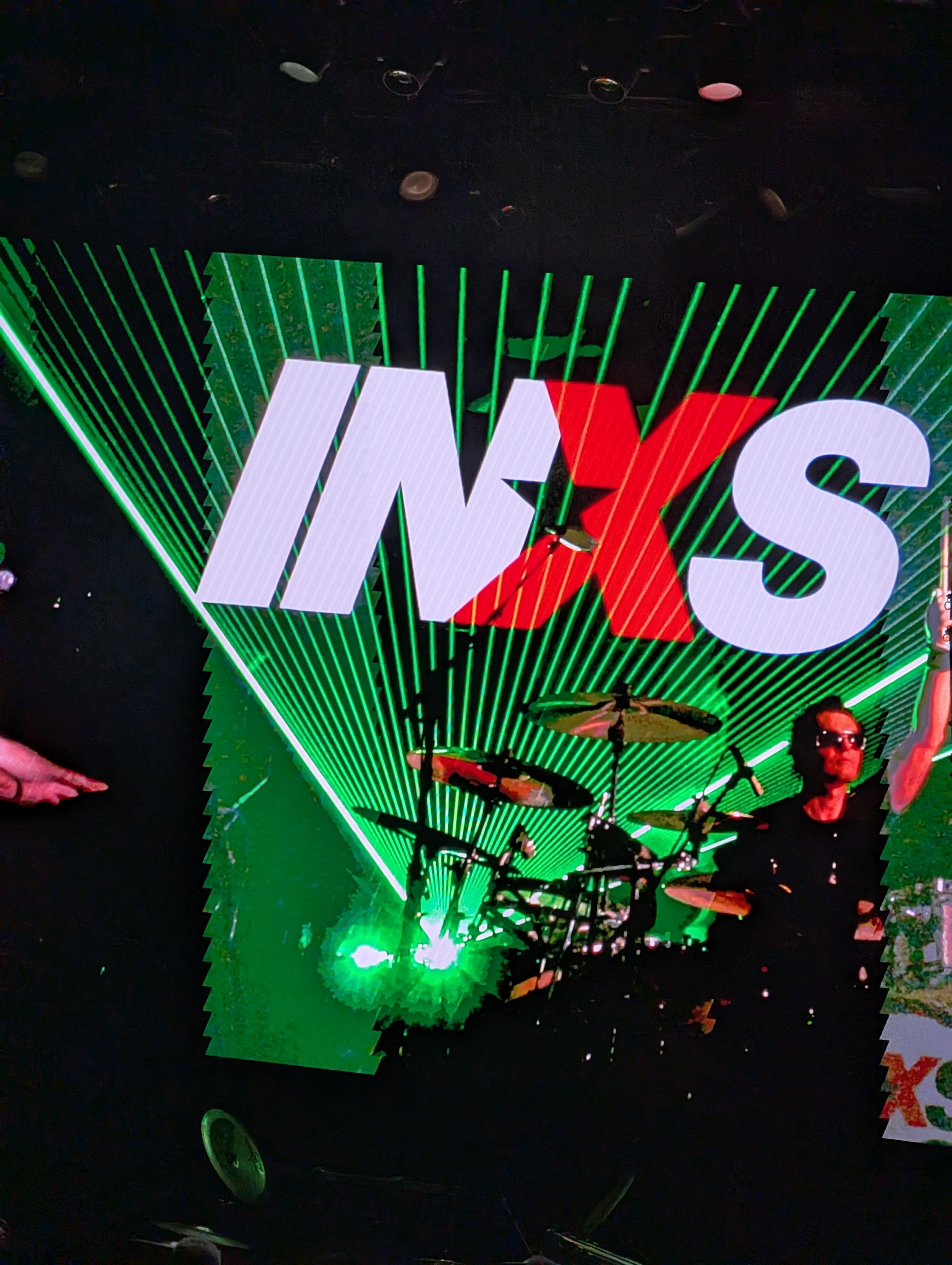
But Rock Star: INXS and Rock Star: Supernova still stood apart from the rest.
Those shows weren’t trying to manufacture influencers, internet celebrities, or short-term viral personalities.
They were trying to find real frontmen for real rock bands in front of real musicians and real fans.
When Rock Star: INXS premiered on CBS in July 2005, reality television was still evolving. Shows like American Idol were massively popular, but Rock Star: INXS felt completely different because the stakes actually felt real.
The contestants were competing to become the new lead singer for the legendary band INXS following the loss of Michael Hutchence in 1997.
That alone changed the entire tone of the show.
The contestants weren’t competing for random internet fame or temporary television exposure.
They were competing to front a globally recognized rock band, survive industry pressure, handle touring culture, perform in front of real audiences, and earn the respect of professional musicians.
The series premiered July 11, 2005 and ran through September 20, 2005, eventually crowning J.D. Fortune as the new lead singer of INXS.
CBS followed the success with Rock Star: Supernova in 2006 featuring Tommy Lee of Mötley Crüe, Jason Newsted formerly of Metallica, and Gilby Clarke formerly of Guns N’ Roses searching for a vocalist for their new supergroup.
That season premiered July 5, 2006 and ended September 13, 2006 with Lukas Rossi winning the competition.
Hosted by Dave Navarro and Brooke Burke, the series felt ahead of its time because it blended reality television with actual musicianship, live performance pressure, touring culture, personality, entertainment presence, and real industry criticism instead of overly manufactured television drama.
And honestly, that era was completely different from entertainment culture today.
There was no TikTok algorithm.
No instant viral marketing machine.
No streaming shortcuts.
No creators becoming famous overnight from one clip.
Artists had to grind differently.
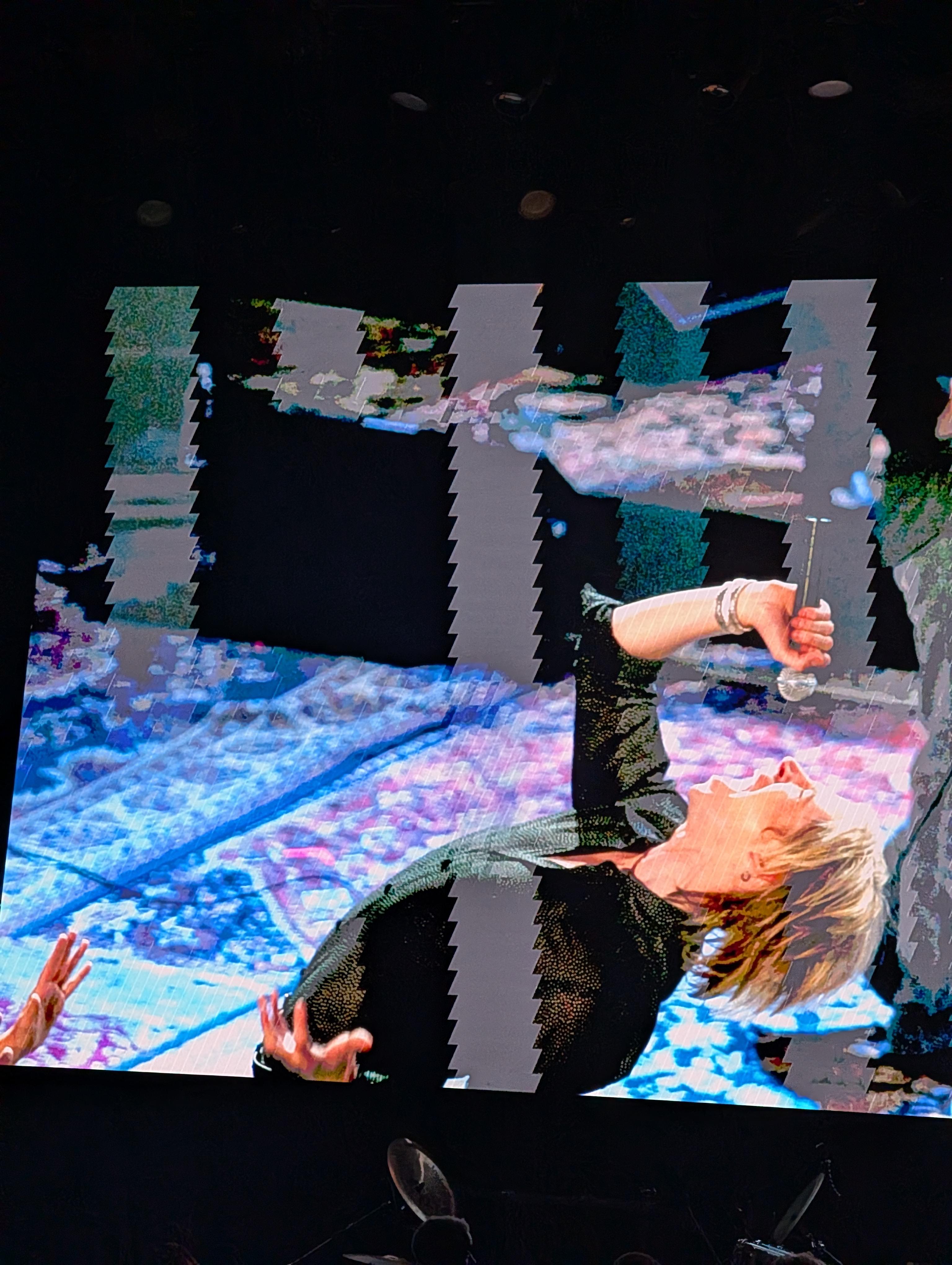
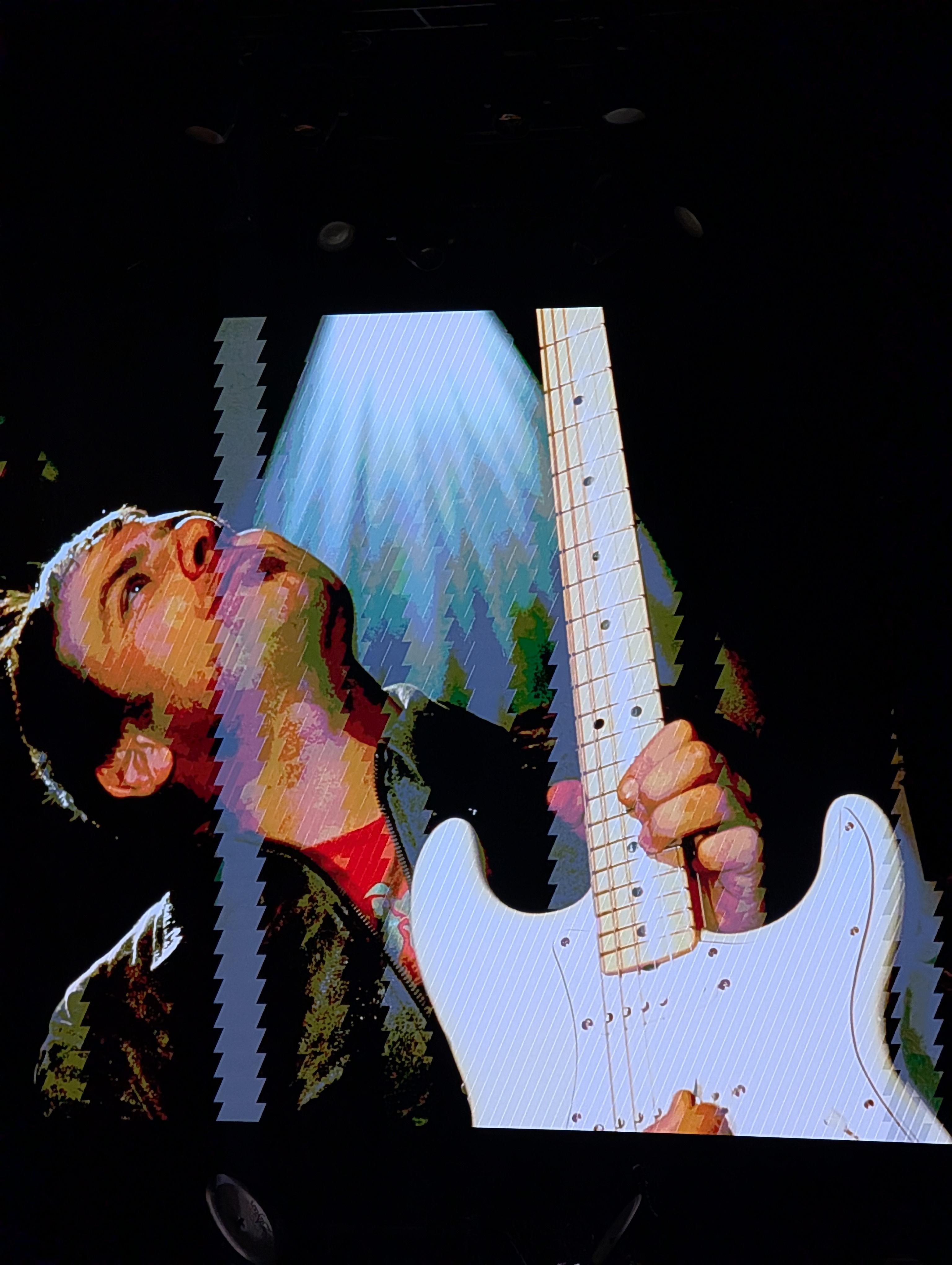
Musicians built fanbases through live performances, street promotion, radio stations, MySpace pages, club flyers, nightlife culture, word-of-mouth, custom car scenes, and nonstop touring.
Entertainment still felt raw, emotional, unpredictable, rebellious, local, and real.
That’s part of why the Rock Star era still feels nostalgic to so many people.
It captured a time when music still felt dangerous, chaotic, emotional, and deeply connected to real-life culture instead of constantly filtered through algorithms and social media branding strategies.
Reality television today often feels more polished, overly edited, brand-controlled, and driven by short attention spans or internet virality.
But Rock Star: INXS and Rock Star: Supernova felt gritty.
The contestants had to prove they could survive rehearsals, criticism from legendary musicians, live audiences, touring schedules, industry pressure, and the chaotic reality of rock-and-roll culture itself.
And honestly, that same raw authenticity is part of what still makes the Rockstar Reunion atmosphere feel special today.
It reconnects people to an era of entertainment that felt more human, more emotional, more rebellious, and more real.
Avalon, Aster Club & Capitol Records Energy
The venue itself also sits in one of the most legendary sections of Hollywood entertainment culture.
Avalon Hollywood is right next to the Aster Club — a place I’ve been to several times with my friends Ted Maier and Brian Chang — and it offers one of the most iconic close-up nighttime views of the legendary Capitol Records Building glowing above Hollywood.
Standing in that area, you can literally feel decades of music history surrounding you.
That energy still exists.
And that’s exactly what I felt walking into the Rockstar Reunion environment.
This wasn’t just another podcast setup or corporate livestream.
It felt more like walking backstage into living entertainment history.
Real musicians.
Real stories.
Real industry people.
Real personalities.
No fake polished image.
Just conversations about touring, fame, burnout, creativity, success, survival, music history, entertainment culture, and the evolution of the industry from people who actually lived through it.
Behind the Scenes People Keep Entertainment Alive
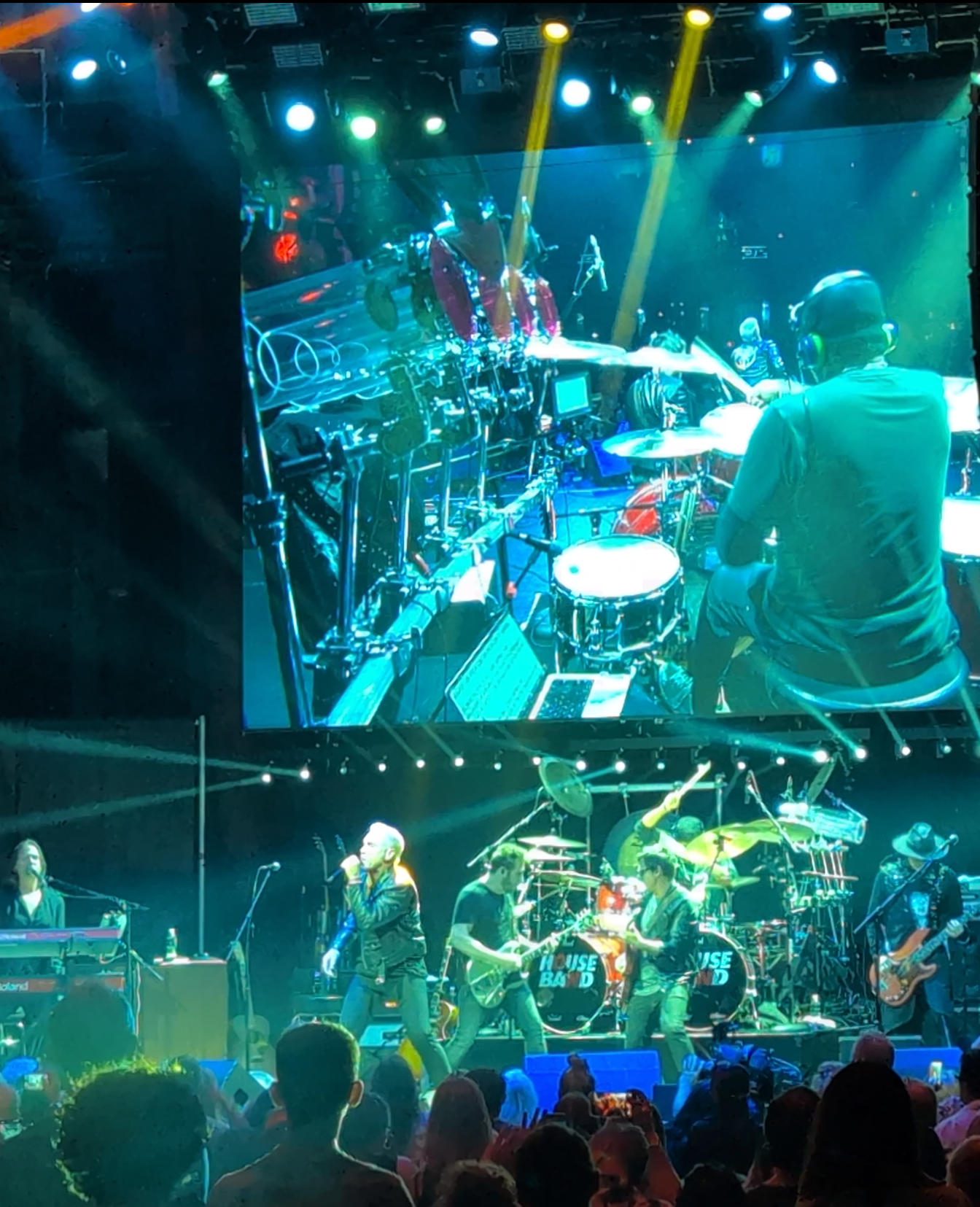
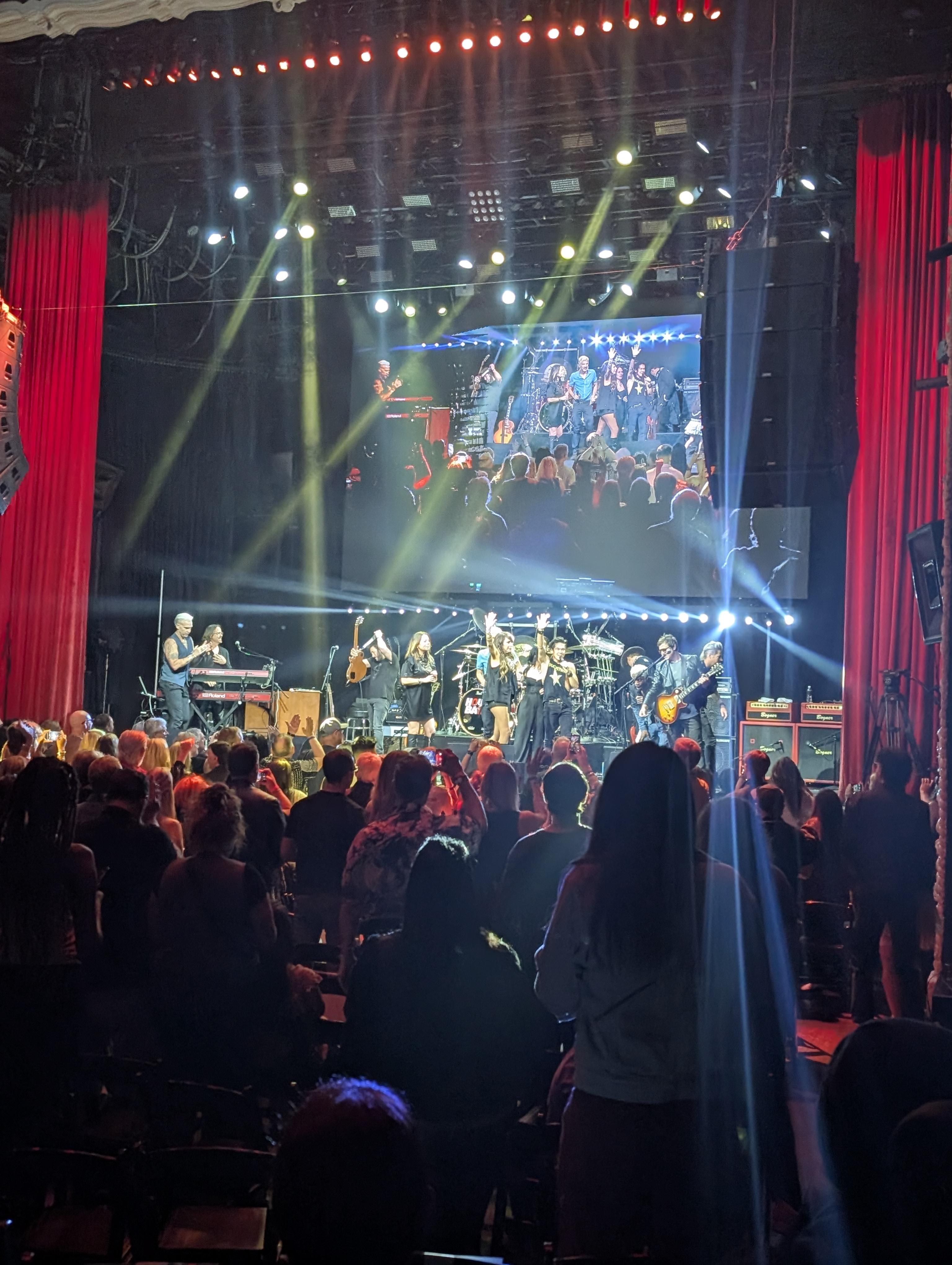
More Photo Here - Link
One of the coolest parts of the Rockstar Reunion experience honestly had nothing to do with celebrity status or cameras.
It was meeting some of the producers, crew members, musicians, cast personalities, and people behind the scenes helping keep the entire production moving.
The Thursday night reunion at Avalon Hollywood featured original Rock Star: INXS and Rock Star: Supernova cast members including Mig Ayesa, Suzie McNeil, Ty Taylor, Toby Rand, Marty Casey, Tara Slone, and Jordis Unga alongside the legendary original House Band featuring Paul Mirkovich, Jim McGorman, Nate Morton, Sasha Krivtsov, and Rafael “Hoffa” Moreira. (see supporting links – bottom of article)
Legendary Los Angeles radio personality Ted Stryker also hosted the night which made the atmosphere feel even more connected to classic LA rock culture.
I even got the opportunity to briefly meet one of the Rockstar Reunion personalities as they passed by and spend time talking with several members of the production crew who were all incredibly cool, welcoming, professional, and down-to-earth.
And honestly, that’s something people outside entertainment sometimes don’t fully understand.
A lot of the magic behind shows, livestreams, festivals, podcasts, concerts, and entertainment productions comes from the people behind the scenes holding everything together.
The producers coordinating talent.
The audio engineers balancing sound.
The camera crews capturing moments.
The livestream operators managing feeds.
The stage managers handling timing.
The creative teams making sure everything flows smoothly.
One of the names that stood out to me while learning more about the event was executive producer and RockStar co-creator David Goffin, who helped originally shape the energy and vision behind the television series itself.
That energy reminded me a lot of the original Rock Star: INXS and Rock Star: Supernova era too.
Those shows worked not only because of the contestants and musicians, but because producers understood how to capture real pressure, backstage emotions, rehearsals, touring culture, personality, and authentic rock-and-roll moments instead of making everything feel overly manufactured.
You could still feel pieces of that same spirit alive inside the Rockstar Reunion atmosphere.
Real conversations.
Real stories.
Real entertainment people who genuinely love music culture.
And honestly, Los Angeles still carries that creative energy.
Even with all the changes happening in media, AI, streaming, podcasts, and technology, there’s still something iconic about LA entertainment culture — the studios, rehearsal rooms, creators, musicians, production teams, random networking collisions, and music conversations happening everywhere throughout the city.
The Rockstar Reunion Global Live Stream Show captures some of that feeling.
It reminds people that entertainment is still built by passionate people behind the scenes who truly care about storytelling, music, culture, and keeping those memories alive for future generations.
Why Music Culture Still Matters
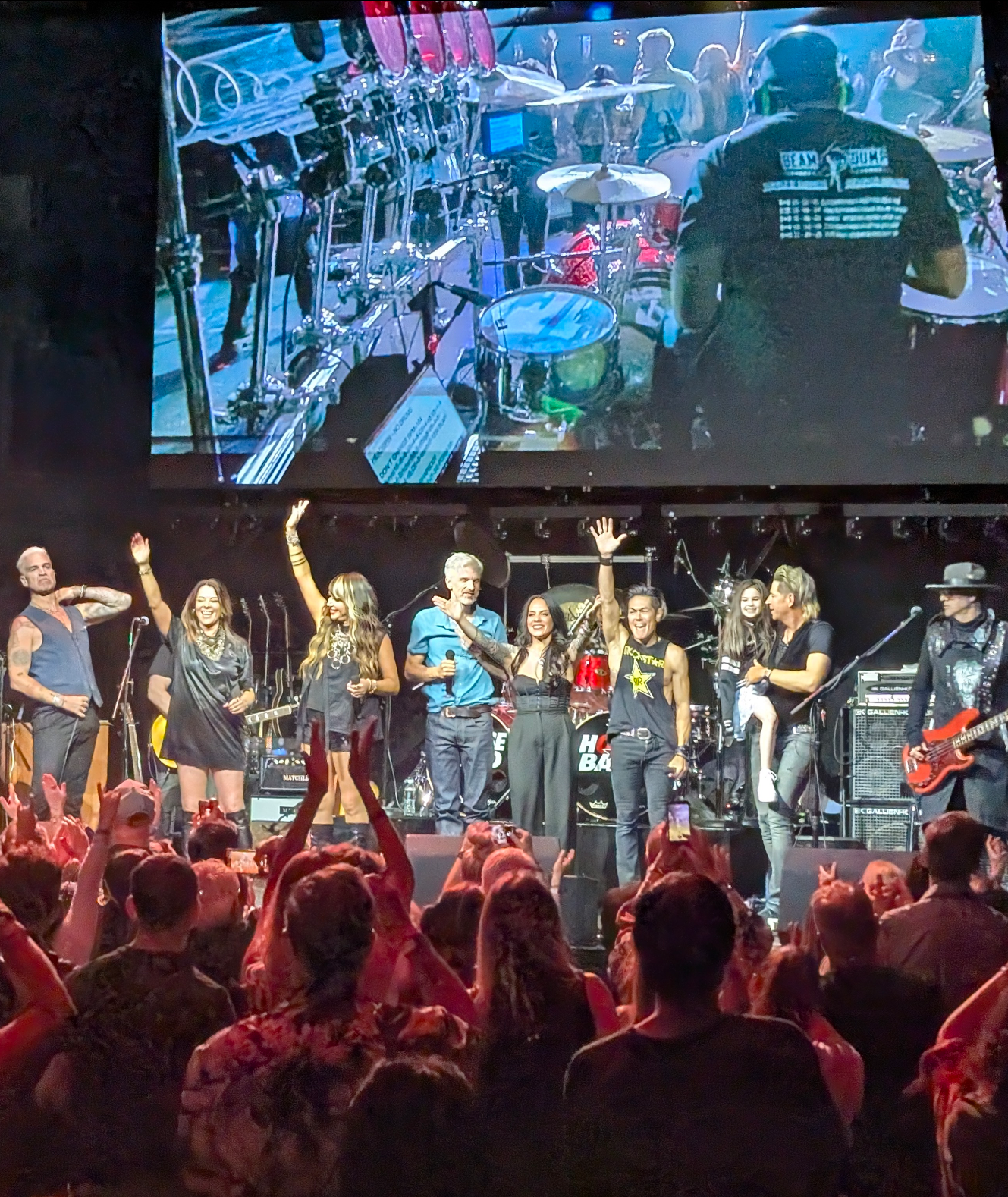
Music culture still matters because music becomes attached to memories.
To heartbreak.
To friendships.
To road trips.
To late nights.
To parties.
To struggles.
To motivation.
To entire chapters of life.
That emotional connection is what keeps entertainment alive long after trends fade away.
And honestly, in many ways, that same emotional connection is exactly what modern branding, media, and licensing are all trying to capture now too.
That’s part of what I took away from both experiences this week — from the Licensing Expo conversations to the Rockstar Reunion atmosphere.
Authenticity still matters.
Real stories still matter.
And the people who truly lived through entertainment culture continue shaping the future of it in ways most people never fully see.
The Real Meaning of Loyalty To My Friend
And honestly, one of the biggest reminders from the night had nothing to do with celebrities, branding, or the entertainment industry itself.
It was loyalty.
The people who support you early.
The people who still show up.
The people fighting through their own battles while still helping keep your dreams alive.
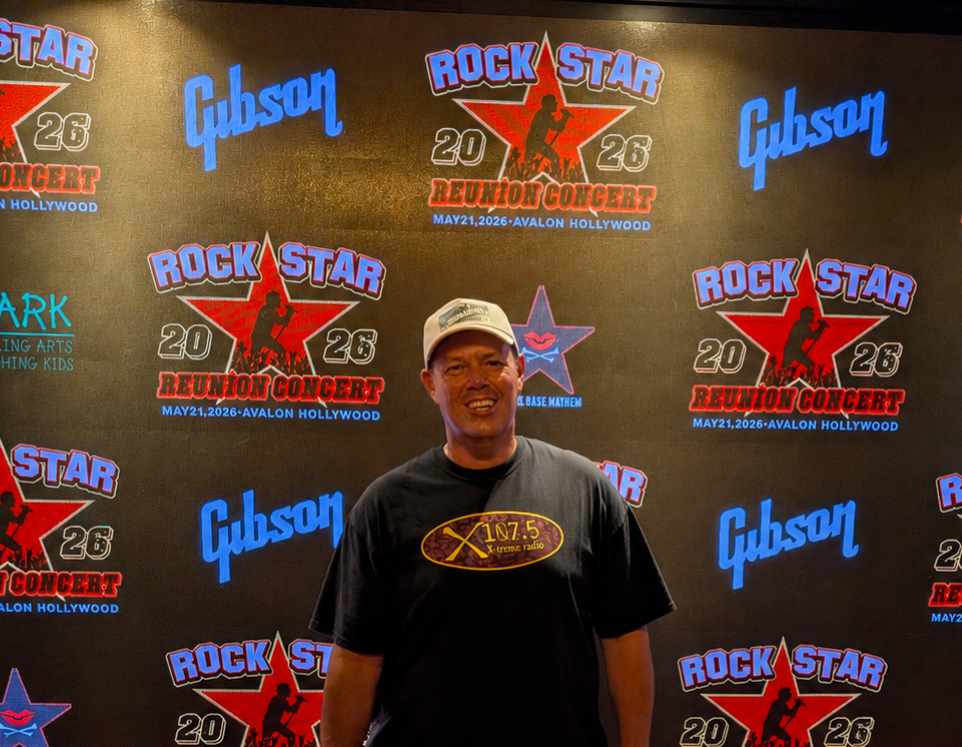
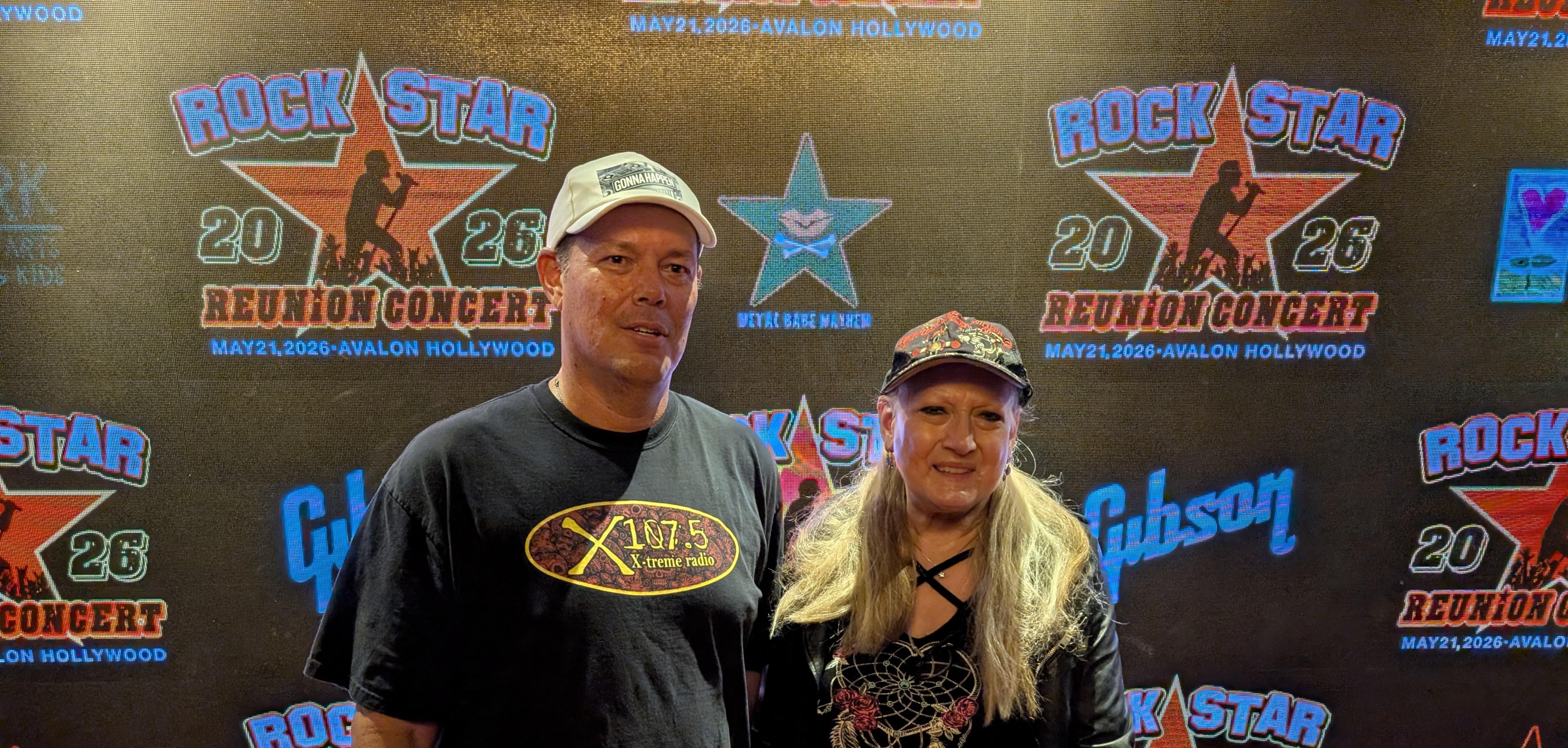
Monica Wilde has been one of those people for me since day one supporting both me and GONNA HAPPEN.
Making that spontaneous trip from the 2026 Licensing Expo to Hollywood ended up becoming one of the most meaningful parts of the entire week.
In a strange way, that spirit felt just as “rock and roll” as the music itself.
— Aaron G. Beebe
Founder – (websites) | GONNA HAPPEN / GONNA HAPPEN
🔗 Socials:
📸 Instagram – @gonnahappendotcom
📘 Facebook Page
🐦 Twitter / X – @gonnahappencom
▶️ YouTube – GonnaHappen Channel
📸 Instagram – @aarongbeebe
📘 Facebook Share Page


